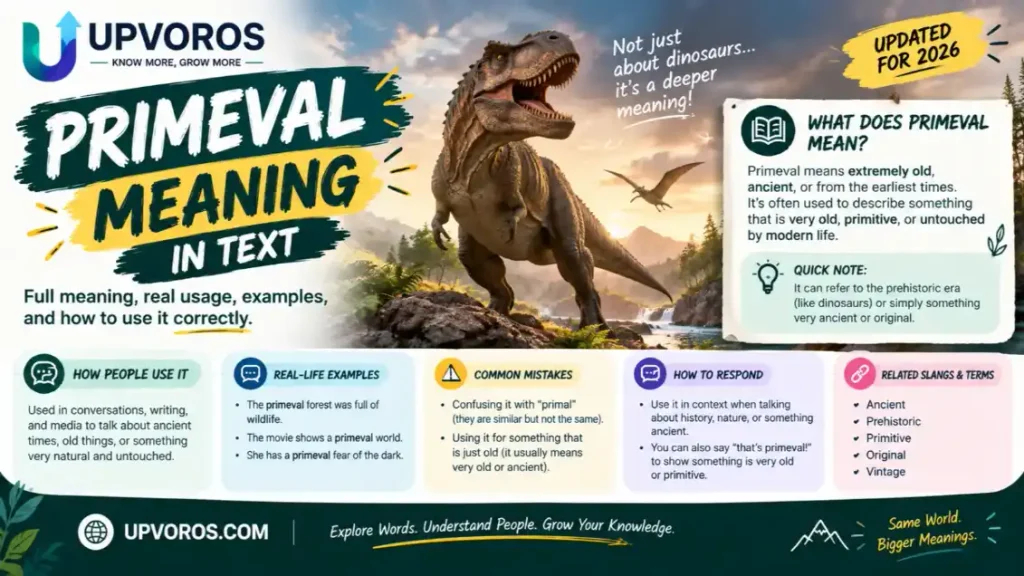
If you came across “primeval” in a text, social media post, book, game, or conversation, you may be wondering what it actually means. Unlike many modern internet terms, primeval is not really a slang abbreviation. It is a standard English word that people sometimes use online to describe something extremely old, ancient, early, or seemingly untouched by modern life.
In simple terms, primeval means belonging to the earliest period of history or existing from the very beginning.
For example, someone might write, “This forest feels primeval,” meaning the forest feels extremely ancient, wild, and almost untouched by humans.
This guide explains primeval meaning in text, chat, social media, gaming, and everyday English, including its tone, examples, common misunderstandings, and how people use it today.
Table of Contents
What Does “Primeval” Mean in Chat or Text?
The simplest primeval meaning is extremely ancient, early, or from the earliest stage of existence.
It can describe something that seems to come from a very distant past, especially a time before modern civilization.
Primeval = ancient + very old + from an early or original period.
For example:
“That cave looks primeval.”
The sender probably means the cave looks ancient, untouched, and almost prehistoric.
Another example:
“I woke up with a primeval urge to eat everything in the fridge.”
Here, “primeval” is being used more playfully. The person is joking that their hunger feels basic, instinctive, or almost animal-like.
Primeval meaning can change slightly with context
Depending on the sentence, primeval can suggest:
- Ancient: Something from a very distant past.
- Prehistoric: Something associated with a time before recorded history.
- early: Something basic or undeveloped.
- Original: Something connected with an early or first state.
- Untouched: Something that seems unaffected by modern civilization.
- Instinctive: A basic, powerful human or animal feeling.
The word comes from Latin roots associated with the first or earliest age, which helps explain why it carries a strong sense of beginnings and ancient history.
Is “primeval” internet slang?
Not exactly.
This is an important distinction if you searched for “primeval meaning slang.”
Primeval is a normal English vocabulary word, not a conventional Gen Z abbreviation or internet acronym. You are unlikely to see it used as routinely as terms such as “FR,” “IMO,” “LOL,” or “IKR.”
However, people can use primeval casually, humorously, dramatically, or ironically online.
That is where things can get interesting.
Someone might call an old-looking computer “primeval” as a joke, even though the computer is only 15 years old. The exaggeration creates the humor.
How People Use “Primeval” in Real Conversations
You probably will not see “primeval” constantly in everyday texting. It is a more descriptive and literary word.
Still, it can appear in several online settings.
Texting
In ordinary texting, someone might use primeval when describing something that feels ancient, wild, or extremely basic.
For example:
“This apartment has a primeval heating system.”
They are probably joking that the heating system is ridiculously old.
A more serious use could be:
“There was something primeval about the landscape.”
This means the landscape felt ancient, wild, and untouched.
Instagram and TikTok
On visual platforms, primeval can work well as a descriptive or humorous caption.
Someone posting pictures of an ancient forest might write:
“A primeval forest hiding in the mountains.”
That sounds atmospheric and serious.
Someone posting a picture of their chaotic morning might write:
“Primeval survival instincts kicked in.”
That version is deliberately dramatic.
The word can therefore feel poetic in one post and funny in another.
Snapchat
On Snapchat, primeval would generally depend on the user’s personal style.
A friend might send:
“My room is giving primeval cave.”
They are probably not making a scientific claim. They mean the room looks dark, messy, early, or barely proper.
Discord
In Discord communities, especially gaming and fandom servers, primeval can be used for dramatic descriptions.
For example:
“That boss has some primeval evil energy.”
The speaker means the boss feels like an ancient, primordial, almost prehistoric form of evil.
It can also be used sarcastically:
“Bro is using a primeval keyboard.”
That simply means the keyboard looks absurdly old.
Dating apps
Primeval is not a typical dating-app abbreviation or pickup term.
If someone uses it in a dating profile or conversation, it is more likely to be playful, intellectual, poetic, or deliberately unusual.
For example:
“Looking for someone who enjoys primeval forests and terrible coffee.”
Here, primeval creates an adventurous, slightly literary tone.
If someone says:
“I felt a primeval connection.”
They probably mean the connection felt deep, instinctive, powerful, or strangely natural.
Forums and gaming chats
Gaming communities may use primeval when talking about ancient creatures, fantasy worlds, prehistoric settings, or powerful forces.
For example:
“That dragon looks primeval.”
This suggests the dragon looks ancient and primordial, rather than simply old.
In a fantasy game, “Primeval” might also appear as part of a character name, ability, creature, item, faction, or title. In that situation, the capitalization and surrounding game-specific context matter.
When does “primeval” sound natural?
It works naturally when you are describing something:
- Ancient
- Wild
- early
- Prehistoric
- Untouched
- Instinctive
- Extremely old-looking
It can sound awkward if you use it where a simpler word like old, ancient, or early would communicate the idea better.
For example:
“My phone is primeval.”
This is understandable, but in normal conversation, “My phone is ancient” sounds more natural.
On the other hand:
“The forest has a primeval atmosphere.”
sounds completely natural because the word captures more than simple age.
Real-Life Examples of “Primeval” in Text Messages
Here are some realistic examples showing how primeval meaning in text can change depending on context.
Example 1: Talking about nature
A: “The forest was completely silent.”
B: “That sounds primeval.”
Meaning:
B means the forest felt ancient, wild, untouched, and far removed from modern life.
Example 2: Joking about an old computer
A: “My dad still has a computer from 2008.”
B: “That thing is primeval.”
Meaning:
B is exaggerating for humor. They mean the computer is ridiculously old by modern standards.
Example 3: Talking about hunger
A: “I haven’t eaten since breakfast.”
B: “My primeval instincts would have taken over by now.”
Meaning:
The speaker is joking that their hunger has become basic, powerful, and instinctive.
Example 4: Describing a movie
“The monster felt primeval.”
Meaning:
The monster seemed ancient, primal, and powerful, rather than simply old.
Example 5: Social media caption
“Found a primeval-looking forest on today’s hike.”
Meaning:
The forest looked ancient, wild, and largely untouched.
Example 6: Gaming
“That boss has primeval energy.”
Meaning:
The boss gives the impression of being ancient, primordial, extremely powerful, or connected to an ancient force.
Example 7: Sarcastic use
“Welcome to my primeval Wi-Fi router.”
Meaning:
The router is not literally prehistoric. The speaker is joking that it is so old or outdated that it feels prehistoric.
Common Mistakes & Misunderstandings
Because primeval is not conventional internet slang, people can sometimes misinterpret it.
1. Thinking it means simply “old”
Primeval can mean old, but it usually carries a stronger idea.
Old simply means something has existed for a long time.
Primeval suggests something connected with an extremely early, ancient, early, or original period.
Compare:
“An old forest.”
This tells you the forest has been there for a long time.
“A primeval forest.”
This suggests a forest that feels ancient, wild, and largely untouched.
2. Assuming it always means prehistoric
Primeval and prehistoric can overlap, but they are not identical.
Prehistoric generally refers to periods before written historical records.
Primeval is broader. It can describe something ancient, early, original, or instinctive without referring to a specific prehistoric period.
For example:
“A primeval fear.”
This does not mean a fear from a specific prehistoric era. It means a deep, basic, instinctive fear.
3. Treating it like a Gen Z abbreviation
There is no standard texting expansion such as:
PRIMEVAL = something…
That is not how the word works.
It is a complete English adjective, not an acronym.
4. Using it when “ancient” sounds better
Sometimes people reach for an unusual word when a simple one works better.
For example:
“My grandmother has a primeval microwave.”
This is understandable as a joke, but:
“My grandmother has an ancient microwave.”
sounds more natural.
Use primeval when you want the additional sense of something early, primordial, wild, or from an extremely early state.
5. Confusing “primeval” with “early”
The words are related in some contexts, but they are not perfect synonyms.
early often describes something simple, undeveloped, or lacking modern technology.
Primeval emphasizes extreme age, earliest origins, or an ancient and almost untouched quality.
How to Respond When Someone Sends You “Primeval”
There is no special response required.
Because primeval is a regular English word, your response should depend on what the person is actually talking about.
If they are describing something ancient
You can respond naturally:
“Yeah, it really does look ancient.”
Or:
“I know what you mean. It looks untouched.”
If they are joking
Match the humor:
“That is one way to describe it.”
Or:
“Calling it primeval is generous.”
If you are unsure what they mean
Ask:
“Do you mean ancient or early?”
That is completely reasonable.
If they use it in a serious or poetic way
You can simply respond to the idea rather than the vocabulary:
“Yeah, I get that. It has a really ancient feel to it.”
Should you use “primeval” back?
You can, but you do not need to.
If it feels natural in your vocabulary, use it. If not, ancient, prehistoric, early, wild, or old-fashioned may sound more conversational.
Is “Primeval” Still Used in 2026?
Yes, but it is important to understand how it is used.
In 2026, primeval is still a standard English word, but it is not one of the major internet slang terms dominating everyday texting.
You are more likely to encounter it in:
- Books and articles
- Nature writing
- Fantasy and science fiction
- Gaming
- Film and entertainment discussions
- Social media captions
- Memes using exaggerated language
- Academic or descriptive writing
- Conversations about ancient history and prehistoric environments
Gen Z vs. Millennial usage
There is not a major generational difference in the basic definition.
Both Gen Z and Millennials are likely to understand primeval from context, although neither generation typically uses it as a high-frequency texting abbreviation.
The difference is more about style.
A younger social-media user might use it ironically:
“My laptop is primeval.”
A writer, nature enthusiast, or fantasy fan might use it literally:
“The region contains remnants of a primeval ecosystem.”
So the word has not disappeared. It simply belongs to a more descriptive and expressive part of the vocabulary than mainstream chat slang.
Primeval vs. Similar Words
Understanding related words makes the meaning much easier to remember.
Primeval vs. Ancient
Ancient means extremely old, especially from a distant historical period.
Primeval can mean ancient, but often adds the idea of something original, early, primordial, or untouched.
Primeval vs. Prehistoric
Prehistoric refers specifically to periods before recorded history.
Primeval is broader and can describe an ancient or early quality without referring to a specific historical period.
Primeval vs. early
early means simple, undeveloped, or technologically basic.
Primeval emphasizes an ancient or earliest state.
Primeval vs. Primordial
Primordial is one of the closest related words.
It often means existing from the beginning or belonging to the earliest stage of something.
For example:
“primordial forces”
and
“primeval forces”
can have very similar meanings in fantasy, literature, and dramatic writing.
Primeval vs. Primal
Primal often refers to basic instincts, emotions, or fundamental drives.
For example:
“a primal fear”
means a deeply instinctive fear.
Primeval can also have this feeling in certain contexts, but its stronger association is with ancient or earliest origins.
Related Internet Slang to Explore
Although primeval itself is not internet slang, users searching for its meaning may also encounter modern terms such as:
- FR — “for real”
- NGL — “not gonna lie”
- IMO — “in my opinion”
- IYKYK — “if you know, you know”
- POV — “point of view”
- IRL — “in real life”
- TL;DR — “too long; didn’t read”
- NPC — a term borrowed from gaming that can describe someone behaving predictably or without independent thought
These terms belong to modern online communication, while primeval remains a conventional English adjective rather than a chat abbreviation.
FAQs:
What does primeval mean in simple words?
Primeval means extremely ancient, early, or belonging to the earliest period of existence. It can also describe something that feels ancient, wild, or untouched.
What does “primeval” mean in text?
In text, primeval usually means ancient, prehistoric-looking, early, or very old. In casual messages, it can also be used humorously to exaggerate how old or outdated something seems.
Is primeval a slang word?
No. Primeval is a standard English adjective, not a conventional internet slang term or texting abbreviation. People can use it casually online, but the word itself is not slang.
Is primeval the same as prehistoric?
Not exactly. Prehistoric usually refers to periods before written historical records, while primeval has a broader meaning connected with ancient, earliest, early, or original conditions.
Can I use primeval in a casual conversation?
Yes. It is grammatically normal, but it can sound more literary or dramatic than everyday words such as “old” or “ancient.” It works especially well when you want to emphasize something ancient, wild, early, or untouched.
Conclusion:
The easiest way to remember primeval meaning is:
Primeval = extremely ancient, early, or connected with the earliest period of existence.
It is not a typical Gen Z or Millennial texting abbreviation, so if you found it in a chat, do not look for a hidden acronym expansion. Look at the surrounding sentence.
If someone says a forest feels primeval, they probably mean it feels ancient and untouched. If they call an old laptop primeval, they are probably joking about how outdated it is. If they describe a feeling as primeval, they may mean it is deeply instinctive or basic.
In modern online communication, context matters more than ever. Once you understand the basic idea behind the word, its different uses become much easier to recognize.
What’s your favorite chat abbreviation? Drop it in the comments!

I’m the voice behind upvoros, mixing creativity with humor to craft puns that hit just right. When I’m not playing with words, I’m busy making content that feels fun, fresh, and relatable.