If you searched for “AGM battery meaning,” you probably saw the term on a car battery label, product listing, charger, or vehicle manual and wondered what those three letters actually mean.
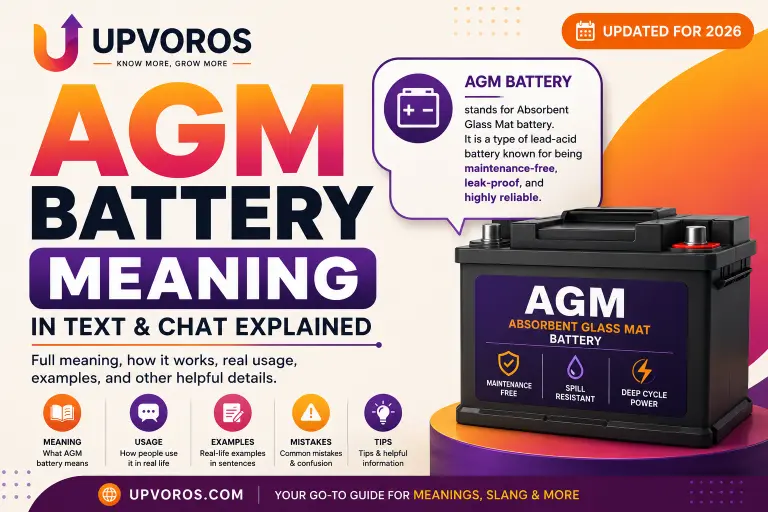
AGM stands for Absorbent Glass Mat. An AGM battery is a type of sealed, valve-regulated lead-acid battery in which the electrolyte is held in a fine fiberglass mat rather than freely flowing around the plates.
In simple terms, an AGM battery is a more specialized type of lead-acid battery designed to provide strong starting power, good vibration resistance, low maintenance, and better support for vehicles with higher electrical demands.
This guide explains AGM battery meaning, how AGM technology works, how it compares with a regular flooded battery, where AGM batteries are used, and what you should know before replacing one.
Table of Contents
What Does “AGM Battery” Mean?
AGM battery means “Absorbent Glass Mat battery.”
The name describes how the battery stores its electrolyte. Instead of having sulfuric-acid electrolyte freely moving around inside the battery, the electrolyte is absorbed and held within very fine glass-fiber mats positioned between the lead plates.
That design makes AGM batteries different from traditional flooded lead-acid batteries.
AGM battery meaning in simple English
Think of the glass mat as a sponge.
The sponge-like material holds the battery’s electrolyte close to the lead plates. This helps create a compact, sealed battery that can deliver high current while being much less prone to spilling under normal conditions.
AGM batteries are commonly described as:
- Absorbent Glass Mat batteries
- Absorbed Glass Mat batteries
- AGM lead-acid batteries
- Valve-regulated lead-acid (VRLA) batteries
The exact wording can vary between manufacturers, but AGM refers to the battery’s internal construction rather than a social-media abbreviation or slang term.
That distinction matters if you searched “AGM meaning in text” or “AGM meaning slang.” In the context of cars, motorcycles, boats, RVs, backup power, and battery chargers, AGM almost always refers to Absorbent Glass Mat technology.
How Does an AGM Battery Work?
An AGM battery still uses the basic lead-acid chemistry found in conventional lead-acid batteries. The major difference is how the electrolyte is held inside the battery.
A simplified AGM battery contains:
- Positive lead plates
- Negative lead plates
- Electrolyte
- Fiberglass separators or mats
- A sealed battery case
- Valves that regulate internal pressure
The fiberglass mat absorbs the electrolyte and keeps it in close contact with the plates. This construction reduces the movement of free liquid inside the battery and contributes to AGM’s spill-resistant design.
AGM technology also has relatively low internal resistance, which helps it deliver high currents when needed.
That is particularly useful when a vehicle needs a strong burst of power to start the engine or when several electrical systems are operating.
Why is it called “glass mat”?
The separator is made from fine glass fibers.
It is not a sheet of ordinary household glass. The material is engineered into a porous mat that can hold the electrolyte while allowing the electrochemical reactions needed for the battery to operate.
So when someone says “AGM battery,” the important word is really mat. The acronym tells you something about the battery’s internal structure.
How People Use “AGM Battery” in Real Conversations
Unlike internet slang, AGM is usually used as a technical abbreviation.
You are most likely to encounter it when talking about:
- Car batteries
- Start-stop vehicles
- Motorcycles
- Boats
- RVs
- Backup power systems
- UPS systems
- Solar and off-grid battery setups
- Battery chargers
- Automotive repair
- Battery replacement
A mechanic might say:
“Your car needs an AGM battery.”
A parts store employee might ask:
“Is the original battery AGM?”
A vehicle owner might post:
“Can I replace my AGM battery with a regular one?”
And someone shopping online might search:
“12V AGM battery”
In these situations, AGM is not slang. It is a battery technology specification.
AGM battery in texting and online chats
You may occasionally see phrases such as:
“Need an AGM for my BMW.”
or
“My AGM battery died.”
The abbreviation still has the same technical meaning.
There is no special Gen Z, Millennial, TikTok, Snapchat, Discord, or dating-app meaning that should automatically be assumed when AGM appears alongside words such as battery, car, charger, voltage, CCA, or Ah.
Context is the giveaway.
Real-Life Examples of “AGM Battery” in Text Messages
Example 1
Person A: “What battery did you put in the car?”
Person B: “An AGM.”
What they mean: They installed an Absorbent Glass Mat lead-acid battery.
Example 2
Person A: “Why is this battery more expensive?”
Person B: “It’s AGM and the car has start-stop.”
What they mean: They are referring to the battery’s technology and the vehicle’s electrical requirements.
Example 3
Person A: “Can I use my normal charger?”
Person B: “Check if it has an AGM mode.”
What they mean: AGM batteries can have different charging requirements from conventional flooded lead-acid batteries, so the charger should support the battery type and manufacturer’s specifications.
Example 4
Person A: “The battery label says AGM. What does that mean?”
Person B: “Absorbent Glass Mat. It’s basically a sealed lead-acid battery with the electrolyte held in fiberglass mats.”
What they mean: This is the straightforward technical definition.
Example 5
Person A: “My battery keeps dying after short trips.”
Person B: “Get the charging system checked before replacing the AGM.”
What they mean: A battery problem is not automatically proof that the battery itself is defective. The vehicle’s charging system, electrical loads, battery condition, and usage pattern can all matter.
AGM Battery vs Regular Battery
One of the biggest reasons people search for AGM battery meaning is that they want to know whether AGM is actually different from a normal car battery.
Yes.
A conventional flooded lead-acid battery contains liquid electrolyte that freely surrounds the plates. An AGM battery holds the electrolyte in fiberglass mats.
| Feature | AGM Battery | Conventional Flooded Battery |
|---|---|---|
| Electrolyte | Held in glass mat | Free-flowing liquid |
| Construction | Sealed/valve-regulated | Flooded lead-acid |
| Spill resistance | Very high under normal conditions | Lower |
| Maintenance | Generally maintenance-free | Traditional designs may require more attention |
| Vibration resistance | Strong | Generally lower |
| High-current performance | Strong | Good, depending on battery |
| Start-stop suitability | Often well suited | Not always suitable |
| Price | Usually higher | Usually lower |
The exact performance difference depends on the battery design and application. AGM is not automatically “better” for every vehicle.
Why Do Cars Use AGM Batteries?
Modern vehicles can place much greater electrical demands on their batteries than older vehicles.
Features such as:
- Start-stop systems
- Heated seats
- Advanced infotainment
- Driver-assistance electronics
- Sensors
- Power accessories
- Vehicle connectivity
- High electrical loads while the engine is off
can increase the demands placed on the battery.
AGM batteries are commonly used in vehicles with start-stop systems and high electrical loads because they can provide strong starting performance and tolerate repeated cycling better than many conventional flooded designs.
However, do not assume that every modern car requires AGM. The correct battery type depends on the vehicle manufacturer’s specifications.
Advantages of AGM Batteries
AGM technology has several practical benefits.
1. Low-maintenance design
AGM batteries are sealed and do not normally require the routine water addition associated with traditional serviceable flooded batteries.
2. Good vibration resistance
The internal construction helps AGM batteries handle vibration well, which is useful in automotive, powersports, marine, and other demanding applications.
3. Strong starting power
AGM batteries can deliver high current, making them useful for engine starting applications. Battery University notes AGM’s low internal resistance and ability to provide high currents on demand.
4. Better support for cycling
Many AGM batteries can handle repeated charge and discharge cycles better than ordinary flooded starting batteries, although actual cycle life varies significantly by design and usage.
5. Spill-resistant construction
Because the electrolyte is absorbed into the glass mat rather than freely sloshing around, AGM batteries are designed to be non-spillable under normal use.
6. Low self-discharge
AGM batteries generally have relatively low self-discharge, making the technology useful in applications where the battery may sit unused for periods of time.
Disadvantages of AGM Batteries
AGM batteries are not perfect.
They usually cost more
An AGM battery typically costs more than a basic flooded lead-acid battery.
Charging needs attention
Using the correct charging profile is important. AGM batteries should be charged according to the battery manufacturer’s specifications, and a charger should be compatible with AGM technology when required.
They can be damaged by incorrect charging
Overcharging, excessive heat, or inappropriate charging settings can shorten battery life.
AGM does not mean “indestructible”
An AGM battery can still become discharged, sulfated, damaged, or worn out. Sealed construction does not eliminate normal battery aging.
Common Mistakes & Misunderstandings
Mistake 1: Thinking AGM is a slang abbreviation
If you searched “AGM meaning slang,” the context matters.
When AGM appears next to battery, car, charger, 12V, CCA, or Ah, it means Absorbent Glass Mat.
It is not a modern texting term.
Mistake 2: Assuming every AGM battery is the same
AGM describes a battery technology. It does not tell you the battery’s exact:
- Voltage
- Capacity
- Cold-cranking rating
- Physical dimensions
- Terminal arrangement
- Cycle-life rating
Those specifications still need to match the application.
Mistake 3: Assuming AGM always means “better”
AGM can be the better choice for a particular application, but the correct battery is the one that matches the vehicle or equipment.
Putting a more expensive battery into a system that does not need it does not automatically improve performance.
Mistake 4: Treating AGM and gel batteries as identical
Both are forms of sealed/valve-regulated lead-acid technology, but their electrolyte systems are different.
AGM uses a fiberglass mat to hold the electrolyte, while gel batteries use a silica-based gel structure.
Mistake 5: Replacing an AGM battery without checking vehicle requirements
Some vehicles are designed around a specific battery type and charging strategy.
If the original battery is AGM, check the owner’s manual or manufacturer specifications before switching to another technology.
How to Respond When Someone Says “AGM Battery”
Because AGM is a technical abbreviation, you normally do not need a special slang response.
Here are natural replies:
If you understand it:
“Yeah, the car takes an AGM battery.”
If you are unsure:
“Do you mean Absorbent Glass Mat?”
It If you’re buying one:
“What size and CCA do I need?”
If someone recommends it:
“Is AGM required for this vehicle, or is it optional?”
😂If you’re checking a replacement:
“Does this battery match the original AGM specification?”
🤣If you’re not sure what someone means, asking for clarification is better than guessing.
Is “AGM Battery” Still Used in 2026?
Yes. AGM remains a widely used battery technology in 2026.
It is especially relevant in modern vehicles, start-stop systems, powersports applications, marine and RV setups, and backup-power equipment. Current battery information from major manufacturers continues to identify AGM batteries for vehicles with start-stop systems and high electrical demands.
So unlike fading internet slang, AGM has not become outdated.
Its meaning has also remained stable. If you see AGM battery in a 2026 product listing, vehicle manual, repair discussion, or battery shop, you should understand it as Absorbent Glass Mat battery technology.
Gen Z vs Millennial usage
There is not really a generational difference in the meaning.
A Gen Z user, Millennial, mechanic, engineer, or car enthusiast is generally using AGM as the same technical abbreviation when discussing batteries.
The difference is more likely to be in how casually someone explains it.
For example:
“Need an AGM for my car.”
is casual automotive shorthand.
“The vehicle requires a 12-volt AGM lead-acid battery.”
is more technical.
The underlying meaning is the same.
Related Battery Terms & Abbreviations
Understanding AGM becomes much easier when you know the abbreviations that often appear beside it.
VRLA
VRLA means Valve-Regulated Lead-Acid.
AGM batteries are commonly classified within the VRLA family.
SLA
SLA means Sealed Lead-Acid.
The term is often used for sealed lead-acid batteries in applications such as backup power and smaller battery systems.
GEL
A gel battery is another type of sealed lead-acid battery, but its electrolyte is immobilized using a gel rather than an AGM fiberglass mat.
CCA
CCA means Cold Cranking Amps.
It indicates a battery’s ability to deliver starting current under a standardized cold-temperature test.
Ah
Ah means ampere-hour.
It is a measure associated with a battery’s charge capacity.
RC
RC means Reserve Capacity.
It indicates how long a battery can supply a specified current under a standardized test.
Start-stop
A start-stop system automatically shuts the engine off when the vehicle stops under appropriate conditions and restarts it when needed. This can place additional demands on the battery, which is one reason AGM technology is used in many start-stop applications.
AGM Battery Meaning: Quick Answer
AGM battery means Absorbent Glass Mat battery.
It is a type of sealed, valve-regulated lead-acid battery that uses a fiberglass mat to hold the electrolyte against the lead plates.
Compared with conventional flooded lead-acid batteries, AGM batteries are known for:
- Strong starting performance
- Spill-resistant construction
- Good vibration resistance
- Low maintenance
- Good cycling capability
- Suitability for many modern start-stop vehicles
The important point is that AGM describes battery technology, not internet slang.
If you see “AGM” on a car battery, charger, vehicle specification, or battery listing, that’s the meaning you should use.
FAQs:
What does AGM stand for in a battery?
AGM stands for Absorbent Glass Mat. It refers to the fiberglass mat that holds the battery’s electrolyte between the lead plates.
Is an AGM battery better than a regular battery?
Not automatically. AGM batteries offer advantages such as strong current delivery, vibration resistance, and good cycling performance, but the best battery depends on the vehicle or equipment’s requirements.
Can I replace an AGM battery with a normal battery?
You should not assume that you can. If a vehicle was designed for an AGM battery, check the manufacturer’s specifications and charging system requirements before installing a different battery type.
Is AGM the same as a gel battery?
No. Both are sealed lead-acid technologies, but AGM holds electrolyte in a fiberglass mat, while gel batteries use a gelled electrolyte.
Is AGM battery still a good choice in 2026?
Yes. AGM remains a relevant technology for many modern vehicles and other applications, particularly where strong starting power, cycling capability, vibration resistance, and low-maintenance operation are useful.
Final Thought:
If you only remember one thing about AGM battery meaning, remember this:
AGM = Absorbent Glass Mat.
It is a type of lead-acid battery that uses fiberglass mats to hold the electrolyte rather than allowing it to freely move inside the battery.
That construction gives AGM batteries several useful characteristics, including strong current delivery, spill-resistant operation, vibration resistance, and low maintenance.
And if you originally searched for “AGM meaning in text” because you thought it might be internet slang, don’t worry. In a battery-related conversation, it is simply a technical abbreviation.
Once you know the context, AGM is actually pretty straightforward.
What battery abbreviation confused you most? Drop it in the comments!

I’m the voice behind upvoros, mixing creativity with humor to craft puns that hit just right. When I’m not playing with words, I’m busy making content that feels fun, fresh, and relatable.