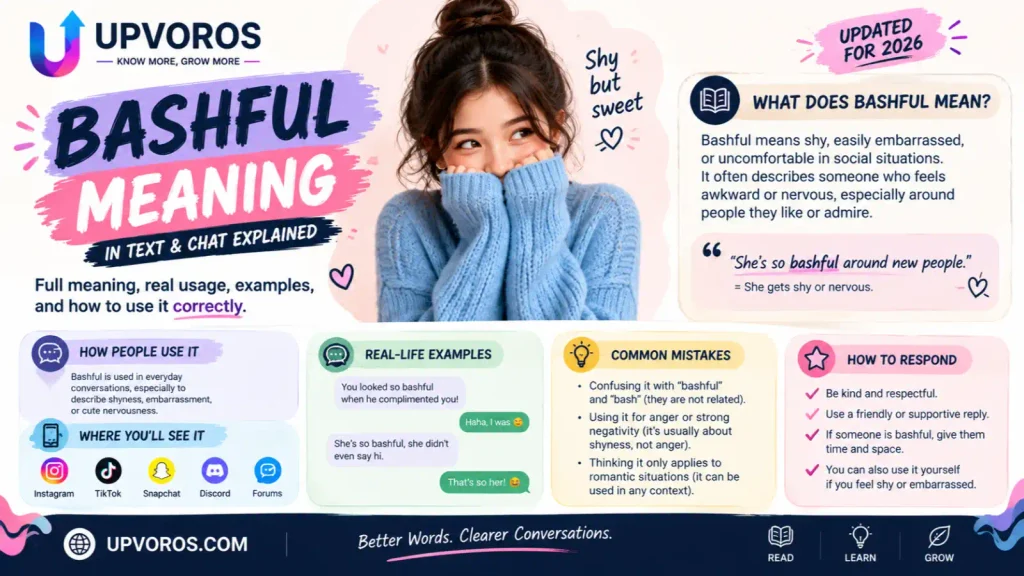
If someone calls you “bashful” in a text, comment, or DM, they usually mean you seem shy, easily embarrassed, or a little hesitant to show your feelings. Depending on the conversation, it can also sound playful, affectionate, teasing, or mildly flirty.
So, what does bashful meaning in text actually imply? Usually, it is not a secret abbreviation or a new internet acronym. “Bashful” is a regular English adjective that has taken on a casual, expressive feel in online conversations.
This guide explains the bashful meaning, how people use the word in chat, what it means on social media and dating apps, and how to respond without overthinking it.
Table of Contents
What Does “Bashful” Mean in Chat or Text?
In chat, bashful means shy, self-conscious, easily embarrassed, or reluctant to be too forward.
For example:
“Why are you being so bashful?”
This could mean:
“Why are you suddenly acting shy?”
Or:
“Aww, you’re bashful.”
This may mean:
“You’re being cute and shy because you’re embarrassed.”
The exact tone depends heavily on the conversation.
Bashful meaning slang: Is it actually slang?
Not exactly.
“Bashful” is not primarily internet slang. It is an established English word. Dictionaries define it as being socially shy or timid and easily embarrassed.
However, people can use ordinary words in a slang-like way online. In texting, “bashful” can feel playful, teasing, affectionate, or flirty, especially when someone notices another person’s reaction to a compliment, romantic comment, or embarrassing question.
That distinction matters.
If someone writes:
“He’s too bashful to ask her out.”
That is simply normal English.
But:
“Look at you getting all bashful.”
sounds much more conversational and teasing.
Where did “bashful” come from?
The word is much older than modern social media.
Merriam-Webster traces bashful to an obsolete sense of bash meaning to become abashed or lose composure, combined with the suffix -ful. Its first known use is recorded as 1548.
Oxford similarly traces it to an obsolete meaning of bash connected with becoming embarrassed or abashed.
So, despite the modern-sounding phrase “bashful meaning slang,” the word itself is centuries old.
Its meaning has remained remarkably stable: shyness, embarrassment, and hesitation around other people.
How People Use “Bashful” in Real Conversations
The interesting part of bashful in chat is not the dictionary definition. It is the tone.
People often use the word to comment on someone’s behavior rather than simply describe a personality.
Texting
In ordinary texting, “bashful” often appears when someone is embarrassed by attention.
Example:
“You got quiet after I complimented you. Bashful now?”
The sender is probably teasing the other person for becoming shy.
Another example:
“Don’t get bashful on me now.”
This can mean:
“Don’t suddenly become shy when it is your turn to speak.”
On Instagram, “bashful” can appear in comments or DMs, especially when someone posts a flattering picture or receives praise.
“Why you looking so bashful in this pic?”
The commenter may be saying that the person looks shy, soft, reserved, or adorably embarrassed.
The word can also be used humorously:
“He was looking bashful after reading the comments.”
Here, it describes a reaction rather than someone’s permanent personality.
Snapchat
Snapchat conversations are often informal and context-heavy, so “bashful” may be used as light teasing.
“You’re bashful today lol”
This might simply mean:
“You’re acting unusually shy today.”
The sender may not be making a serious statement about the person’s personality.
Discord
On Discord, the word can appear in gaming communities, friend groups, and casual conversations.
“Bro got bashful when everyone noticed his crush.”
That is basically:
“He became shy and embarrassed when everyone noticed his crush.”
It can also be deliberately dramatic or meme-like:
“Why so bashful, warrior?”
The humor comes from using a slightly old-fashioned or formal word in a casual setting.
Dating apps
This is where bashful can become more obviously flirty.
Someone might say:
“You’re kinda bashful, aren’t you?”
Depending on the conversation, this could mean:
“You seem shy around me, and I find that cute.”
But don’t automatically assume it is romantic. The surrounding conversation matters.
A person can be bashful about compliments, meeting someone new, discussing personal topics, or simply taking the lead.
Forums and gaming chats
In forums, Reddit-style discussions, and gaming chats, “bashful” is often used descriptively or jokingly.
“He went bashful after getting called out.”
Meaning:
“He became embarrassed and quiet after people noticed his mistake.”
The word can also be intentionally playful because it sounds softer than words such as embarrassed or awkward.
When does “bashful” feel natural?
It works especially well when someone is:
- Avoiding attention
- Getting embarrassed by a compliment
- Acting shy around a crush
- Hesitating to say something
- Becoming quiet after being teased
- Trying not to reveal their feelings
- Acting modest after receiving praise
When can it sound awkward?
Calling someone “bashful” in a very formal or serious situation can sound unusual.
For example:
“You appear bashful regarding the proposed business agreement.”
That is grammatically possible, but it sounds extremely unnatural.
In everyday conversation, you’d probably say:
“You seem hesitant about it.”
Online, “bashful” works best when the situation is personal, light, playful, or slightly teasing.
Real-Life Examples of “Bashful” in Text Messages
Here are some realistic examples of how bashful meaning in text changes with context.
Example 1: After a compliment
Person A: “You looked really good today.”
🤤Person B: “Stoppp.”
Person A: “Why are you getting bashful?”
Meaning: Person B seems embarrassed or shy because of the compliment.
Example 2: A crush gets mentioned
Person A: “So you actually like Alex?”
😊Person B: “No comment.”
Person A: “Lmao, getting bashful now?”
Meaning: Person B is probably embarrassed about having their romantic feelings exposed.
Example 3: Playful teasing
Person A: “You never talk when everyone is around.”
😆Person B: “I’m just quiet.”
Person A: “Sure, bashful.”
Meaning: The sender is teasing them for being shy.
Example 4: Dating conversation
Person A: “Would you actually go on a date with me?”
😍Person B: “Maybe…”
Person A: “Don’t be bashful.”
Meaning: The sender wants the other person to be more direct.
Depending on the relationship, this can be playful or flirty.
Example 5: Social media comment
“Why you looking so bashful here?”
Meaning: The commenter thinks the person looks shy, embarrassed, reserved, or unusually sweet.
Example 6: Gaming chat
“Bro got bashful after missing the final shot.”
Meaning: The player became embarrassed after making a mistake.
The exaggerated wording makes the sentence humorous.
Example 7: Genuine personality description
“She’s naturally bashful around new people.”
Meaning: She is genuinely shy or uncomfortable when meeting unfamiliar people.
This is different from using “bashful” as a joke.
The biggest context clue
Ask yourself:
What happened immediately before someone used “bashful”?
If the answer is:
- a compliment → probably embarrassed or shy
- a crush → possibly flirty or romantically shy
- teasing → probably playful
- a mistake → probably embarrassed
- meeting strangers → probably genuinely shy
- praise → possibly modest or uncomfortable with attention
That one clue usually makes the meaning obvious.
Common Mistakes & Misunderstandings
1. Thinking “bashful” is an abbreviation
It isn’t.
Unlike terms such as LOL, BRB, IMO, or IDK, “bashful” is a normal English word.
Someone typing:
“You’re bashful”
is not using a hidden acronym.
2. Assuming it always means socially anxious
Bashful generally describes shyness or embarrassment, but it does not automatically describe someone’s entire personality.
Someone can be confident and outgoing but still become bashful after receiving a romantic compliment.
For example:
“He’s usually confident, but he gets bashful when people compliment him.”
There is no contradiction.
3. Confusing bashful with embarrassed
The meanings overlap, but they are not identical.
Embarrassed focuses more directly on feeling uncomfortable because of a situation.
Bashful emphasizes shyness, reserve, or hesitation, often with an innocent or softer quality.
Compare:
“She was embarrassed after falling.”
with:
“She became bashful when he complimented her.”
The first focuses on an awkward event. The second focuses on shy behavior.
4. Confusing bashful with coy
These words can overlap, but coy can imply deliberate or affected shyness.
Merriam-Webster notes that bashful suggests hesitant or frightened shyness, while coy can involve pretended shyness.
So:
“She was bashful.”
usually suggests genuine shyness.
Whereas:
“She was being coy.”
can suggest she is intentionally acting shy or evasive.
5. Assuming it is always romantic
This is a common texting mistake.
“Bashful” can certainly appear in flirting, but it can also describe:
- children
- friends
- coworkers
- gamers
- strangers
- someone receiving praise
- someone embarrassed by a mistake
Context determines the tone.
6. Using it with everyone
Calling a stranger “bashful” can sound overly familiar, especially if you are commenting on something personal.
With close friends, it may sound playful.
😍With someone you’re flirting with, it may sound cute or teasing.
😅With a professional contact, a simpler word such as shy, hesitant, or reserved is usually safer.
How to Respond When Someone Sends You “Bashful”
Your response should match the tone of the original message.
If they are teasing you
You can answer:
“Maybe a little.”
Or:
“Who said I’m shy?”
Or:
“I’m not bashful, you’re just embarrassing me.”
If you want to keep it playful
Try:
“You noticed?”
Or:
“Caught me.”
These responses work well when the conversation is already casual.
If the message feels flirty
You could say:
“Maybe you bring that side out of me.”
That is more clearly flirtatious, so only use it if the conversation already has that vibe.
If you’re unsure what they mean
Simply ask:
“What makes you say that?”
This is often better than guessing.
When not to use “bashful” back
Don’t feel like you have to mirror the word.
If someone says:
“Why are you so bashful?”
you can simply reply:
“Haha, I don’t know.”
Natural conversation is more important than matching someone’s vocabulary.
Is “Bashful” Still Used in 2026?
Yes, but it is better described as a normal English word used casually than as a major piece of internet slang.
That distinction is important for anyone searching “bashful meaning slang.”
The word remains in current English usage, including recent published examples. Merriam-Webster’s current entry continues to define it around shyness and self-consciousness and lists recent examples from 2025–2026.
Its online use is more likely to appear in situations where people are:
- teasing someone
- talking about a crush
- reacting to compliments
- describing a shy personality
- making a playful comment
- exaggerating an awkward moment
Gen Z vs. Millennial usage
There is no strict generational rule for “bashful.”
Both Gen Z and Millennials can understand and use it, but the style of use can differ.
A younger user may use it ironically:
“Bro got bashful.”
A Millennial might use it more naturally:
“She’s a little bashful around new people.”
Neither usage is wrong.
The important point is that “bashful” has not become a specialized Gen Z abbreviation. It remains a standard adjective that can take on a more playful internet tone depending on the conversation.
Is “bashful” fading?
There is no good reason to treat it as an obsolete word.
It is less common in everyday speech than very basic words such as shy, but it remains understandable and usable. Current dictionary entries and recent examples show that the word is still active in modern English.
In online conversation, its slightly softer and more playful sound can actually make it useful when someone wants to tease without sounding harsh.
Bashful vs. Similar Words
Understanding nearby words makes the bashful meaning in chat much easier to recognize.
| Word | Basic meaning | Typical tone |
|---|---|---|
| Bashful | Shy or easily embarrassed | Soft, gentle, playful |
| Shy | Uncomfortable or nervous around people | Neutral |
| Embarrassed | Uncomfortable because of a situation | Direct |
| Coy | Shy-looking, sometimes deliberately | Playful or suggestive |
| Timid | Lacking confidence or courage | More serious |
| Reserved | Not openly expressive | Neutral or formal |
| Awkward | Socially uncomfortable or clumsy | Casual, sometimes humorous |
| Self-conscious | Very aware of how others perceive you | Neutral to serious |
Bashful vs. shy
Shy is the simplest and most common word.
“He’s shy around new people.”
Bashful can sound softer or more charming:
“He’s bashful around new people.”
Bashful vs. embarrassed
Someone can be embarrassed without being bashful.
For example:
“I was embarrassed when I forgot her name.”
But:
“I got bashful when she complimented me.”
The second suggests shyness or a reserved reaction.
Bashful vs. awkward
“Awkward” is broader.
Someone may feel awkward because they don’t know what to say, while someone who is bashful is specifically showing shyness or embarrassment.
Related Slangs & Abbreviations
If you’re building a glossary around bashful meaning in text, these related terms are useful to understand.
Shy
The closest everyday synonym for bashful.
“He’s shy around strangers.”
Awkward
Often used online when someone feels socially uncomfortable.
“That conversation got awkward.”
Embarrassed
Used when someone feels uncomfortable because of attention, a mistake, or an unexpected situation.
“I’m so embarrassed right now.”
Coy
Can describe playful or deliberate shyness, especially in romantic situations.
“She’s being coy about her crush.”
Introvert
Describes a personality preference, not simply a moment of shyness.
Someone can be introverted without being bashful.
Blushing
Often associated with bashfulness.
“He started blushing when she complimented him.”
Flustered
Describes being confused, nervous, excited, or embarrassed.
“You totally flustered him.”
Awkward silence
A common online and offline phrase for an uncomfortable pause.
“And then there was just an awkward silence.”
These related terms can make useful internal links if your website has separate articles explaining shy meaning, coy meaning, awkward meaning, flustered meaning, or common texting slang.
FAQs:
What does “bashful” mean in text?
In text, “bashful” usually means shy, easily embarrassed, or hesitant to be forward. Depending on the conversation, it can sound playful, affectionate, teasing, or flirty.
Is “bashful” internet slang?
Not technically. Bashful is a standard English adjective. Online users sometimes use it in a casual or slang-like way, especially when teasing someone who appears shy or embarrassed.
Does bashful mean shy?
Yes. Shyness is the core meaning of bashful. It can also suggest being easily embarrassed or self-conscious.
Does “bashful” mean someone likes you?
Not necessarily. Someone may call you bashful because you seem shy after a compliment or romantic comment, but the word alone does not prove that either person has romantic feelings.
Is bashful still used in 2026?
Yes. Bashful remains a current English word and continues to appear in modern writing. In online conversations, it is often used casually or playfully rather than as a formal vocabulary term.
Conclusion:
The simplest bashful meaning is shy, easily embarrassed, or hesitant to be forward.
In texting and social media, though, the word can carry extra tone. Someone might call you bashful because you got shy after a compliment, became embarrassed when your crush was mentioned, or suddenly went quiet when attention turned toward you.
The key is context.
Bashful is not a secret abbreviation or a specialized Gen Z acronym. It is an established English word that people can use in modern chat in a softer, playful, teasing, or sometimes flirty way.
So if someone says, “Why are you being so bashful?”, they probably mean:
“Why are you acting so shy or embarrassed?”
Now you know what they mean without having to overthink the message.
What’s your favorite chat abbreviation? Drop it in the comments!

I run upvoros with one goal: to make humor easy, smart, and unforgettable. From witty to playful word magic, I create content that feels fun, fresh, and human.