If you’ve seen the word “deemed” in a text, social media post, comment, or online conversation and wondered what it actually means, you’re not alone. The word can sound formal or legal, especially when someone uses it casually online.
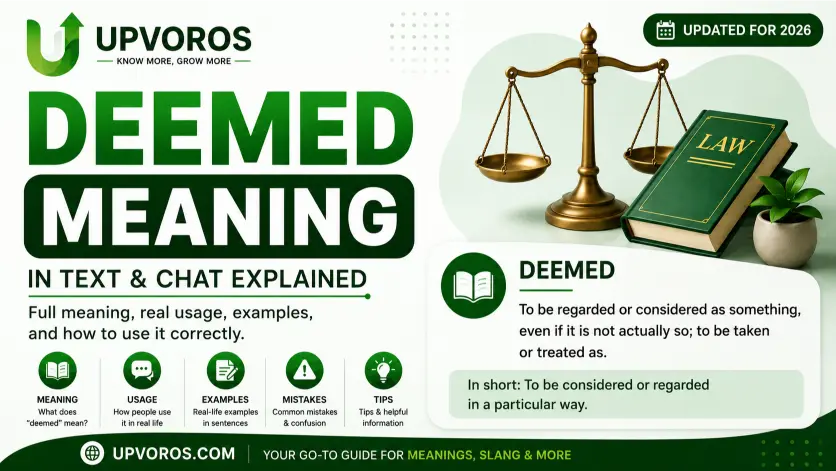
Deemed generally means “considered,” “regarded as,” or “treated as” something. For example, “It was deemed unnecessary” means “It was considered unnecessary.”
But context matters. In everyday chat, “deemed” can sound serious, formal, sarcastic, or even intentionally dramatic. This guide explains the deemed meaning in chat and text, how people use it, what it means in different contexts, and whether it is actually internet slang.
this guide focuses on how modern internet users understand and use the word in texting, social media, gaming, forums, and casual conversations.
Table of Contents
What Does “Deemed” Mean in Chat or Text?
In chat or text, “deemed” usually means “considered,” “judged,” “regarded,” or “decided to be.”
It is not normally an abbreviation or a special Gen Z acronym. It is a standard English word that sometimes appears in casual online conversations because people use it to describe a decision or judgment.
For example:
“That movie was deemed too boring to finish.”
This means:
“That movie was considered too boring to finish.”
Another example:
“You have been deemed worthy.”
This means:
“You have been judged or considered worthy.”
The simple deemed meaning
If you want the quickest possible definition:
Deemed = considered or regarded as something.
The word often appears before an adjective or description:
- deemed acceptable
- deemed necessary
- deemed inappropriate
- deemed funny
- deemed worthy
- deemed important
- deemed harmless
- deemed suspicious
Is “deemed” actually slang?
Not really.
“Deemed” is a normal English verb, not an internet abbreviation like “LOL,” “TBH,” or “IMO.”
However, the way people use it online can be playful. Someone might deliberately use the formal word “deemed” in an obviously casual situation for humor.
For example:
“The snacks have been deemed insufficient.”
A person could simply say, “We need more snacks.” Using “deemed” makes the sentence sound mock-serious.
That contrast between formal wording and an ordinary situation is part of why the word sometimes appears in memes, comments, gaming chats, and casual online conversations.
Where did “deemed” come from?
“Deemed” comes from the verb deem, which has a long history in English. Traditionally, “to deem” means to consider, judge, or regard something in a particular way.
It has long been common in formal writing, especially in legal, business, academic, and official language.
The internet did not create the word. What changed online is the tone and context in which people use it.
A formal-sounding word can become funny when it is used for something extremely ordinary.
For example:
“The group chat has deemed pineapple pizza acceptable.”
The wording sounds almost like an official ruling, even though the subject is just pizza.
How People Use “Deemed” in Real Conversations
You may encounter “deemed” in chat when someone is describing a judgment, decision, classification, or opinion.
It can appear on many platforms, including:
- Text messages
- Instagram comments and captions
- Snapchat conversations
- Discord servers
- Reddit discussions
- Gaming chats
- Dating apps
- Group chats
- Online forums
The meaning usually stays the same, but the tone can change dramatically depending on the situation.
In texting
In normal texting, “deemed” can sound slightly formal.
For example:
“Your excuse has been deemed acceptable.”
This might be a genuine statement, but between friends it can also sound intentionally dramatic.
A more natural casual version would be:
“Okay, your excuse is valid.”
So when someone chooses “deemed” instead of a simpler word, pay attention to the tone.
On Instagram and TikTok
On social media, “deemed” can be used in comments, captions, or discussions about whether something is considered acceptable, attractive, funny, embarrassing, or trendy.
For example:
“This outfit has been deemed a serve.”
The exact wording depends on the community, but the underlying idea is still “this has been considered or judged to be…”
It can also be used humorously:
“The video was deemed too chaotic for the family group chat.”
On Snapchat
Snapchat conversations tend to be casual and fast-moving, so “deemed” may stand out as deliberately formal.
If a friend writes:
“You have been deemed responsible for choosing dinner.”
They probably are not issuing an official ruling. They are joking about giving you the responsibility.
On Discord
Discord is especially interesting because it mixes casual conversation, gaming, memes, communities, and roleplay.
Someone might write:
“You have been deemed unworthy of the voice channel.”
That could be genuine teasing, a joke between friends, or part of a community’s playful style.
In gaming communities, “deemed” can make an ordinary decision sound like an official game ruling:
“That strategy has been deemed illegal.”
The person may simply mean:
“We don’t allow that strategy.”
On dating apps
“Deemed” is less common in casual flirting than simpler words such as “considered,” “valid,” or “approved.”
Still, it can work as playful banter.
For example:
“Your dog has been deemed cute enough to earn a second date.”
The formal wording makes the compliment intentionally funny.
On Reddit and forums
Reddit and other forums often contain more formal vocabulary mixed with internet slang.
A user might write:
“This argument was deemed irrelevant.”
Here, the word may be completely serious.
But another user could write:
“The pizza was deemed worthy of another order.”
That is more playful.
When does “deemed” sound natural?
It sounds natural when you’re talking about:
- A judgment
- A decision
- A classification
- A standard
- An official or unofficial conclusion
- Something being considered a certain way
It can sound awkward when used in a very simple sentence where everyday language would be clearer.
For example:
“I deemed the movie good.”
This is grammatically understandable, but in casual conversation:
“I thought the movie was good.”
sounds much more natural.
What tone does “deemed” create?
Depending on context, “deemed” can sound:
- Formal: “The request was deemed inappropriate.”
- Serious: “The patient was deemed fit for discharge.”
- Sarcastic: “Your excuse has been deemed acceptable.”
- Playful: “The cat has deemed this box its property.”
- Dramatic: “You have been deemed worthy.”
- Mock-official: “The group has deemed Friday pizza night.”
The surrounding words are often more important than the word itself.
Real-Life Examples of “Deemed” in Text Messages
Here are examples showing how deemed meaning in text changes with context.
Example 1: A serious decision
Person A: “Why did they reject the application?”
Person B: “The application was deemed incomplete.”
Meaning: The application was considered incomplete.
This is a formal, straightforward use.
Example 2: Friendly joking
Person A: “Can I come over without bringing anything?”
Person B: “After careful consideration, you have been deemed acceptable.”
Meaning: “Sure, you can come over.”
The phrase is intentionally dramatic.
Example 3: Gaming chat
Player A: “Can we use that strategy again?”
Player B: “No. It has been deemed too risky.”
Meaning: The group has decided that the strategy is too risky.
Example 4: Group-chat humor
Person A: “Who ate the last slice?”
Person B: “You have been deemed the primary suspect.”
Meaning: “We think you probably ate it.”
The word gives the accusation a mock-serious tone.
Example 5: Dating banter
Person A: “I make terrible coffee.”
Person B: “That has been deemed a major red flag.”
Meaning: The person is jokingly saying the bad coffee is a negative trait.
Example 6: Social media
“This trend has officially been deemed embarrassing.”
Meaning: The speaker thinks the trend is embarrassing and is presenting that opinion as though it were an official decision.
Example 7: Sarcasm
“Your five-hour nap has been deemed necessary.”
Meaning: “You clearly needed that nap.”
The sentence is funny because the formal word “deemed” is being applied to an ordinary situation.
Example 8: Context changes everything
“His behavior was deemed inappropriate.”
This sounds serious.
But:
“His dance moves were deemed inappropriate for the family wedding.”
could be serious, humorous, or exaggerated depending on the conversation.
The word itself does not tell you the tone. The surrounding context does.
Common Mistakes & Misunderstandings
Because “deemed” sounds formal, it can create confusion in casual conversations.
Mistake 1: Thinking “deemed” is an internet abbreviation
It isn’t.
Unlike terms such as “BRB,” “IDK,” or “IMO,” deemed is a normal English word.
Online users may use it in slang-like or meme-like ways, but the word itself is not an abbreviation.
Mistake 2: Assuming it always sounds serious
Not necessarily.
Compare:
“The building was deemed unsafe.”
with:
“My outfit has been deemed acceptable.”
The first sounds official. The second could easily be a joke.
Mistake 3: Confusing “deemed” with “proved”
“Deemed” does not necessarily mean something was scientifically or objectively proven.
If someone says:
“The idea was deemed ineffective.”
they mean it was considered or judged ineffective.
That judgment might be based on evidence, opinion, rules, or circumstances.
Mistake 4: Using it when “thought” would be more natural
In casual texting, you usually don’t need to force formal vocabulary into every sentence.
Instead of:
“I deemed the restaurant expensive.”
you could simply say:
“I thought the restaurant was expensive.”
“Deemed” works better when you’re emphasizing a judgment or decision.
Mistake 5: Missing the joke
If a friend says:
“Your request has been deemed worthy.”
they may be deliberately pretending to be an authority figure.
Responding as if they were making a serious legal decision could miss the humor.
How to Respond When Someone Sends You “Deemed”
If someone uses “deemed” and you’re not sure whether they’re being serious, look at the surrounding conversation first.
Safe responses
If you understand what they mean, you can respond normally:
- “Fair enough.”
- “That works.”
- “Agreed.”
- “Valid.”
- “Okay, I’ll take it.”
- “Sounds good.”
If they’re clearly joking, you can play along:
“I accept the ruling.”
or:
“The decision has been noted.”
These responses match the mock-formal tone.
When you should ask for clarification
If the sentence affects something important and you’re unsure what they mean, simply ask:
“What do you mean by deemed?”
There is nothing embarrassing about asking. Context can change the meaning and tone.
Should you use “deemed” back?
You can, especially if the other person is using it playfully.
For example:
Friend: “Your excuse has been deemed acceptable.”
You: “Glad the committee approved it.”
That keeps the joke going without forcing slang into the conversation.
If you’re speaking professionally, however, use the word only when it genuinely fits the context.
Is “Deemed” Still Used in 2026?
Yes, but it is not best described as a new Gen Z slang term.
In 2026, “deemed” remains a standard English word. It continues to appear in formal writing, news, official communication, legal language, workplace discussions, and everyday conversation.
Online, its playful use continues because people often turn formal language into humor.
Gen Z usage
Gen Z users may use “deemed” ironically when they want something to sound like an official ruling.
For example:
“You have been deemed too powerful.”
The humor comes from exaggerating the seriousness of an ordinary statement.
Millennial usage
Millennials may encounter “deemed” in both normal English and internet humor, particularly in Reddit discussions, group chats, memes, gaming communities, and social media.
There is no strict generational meaning attached to the word.
Where is “deemed” most common today?
You are most likely to see it in:
- Formal or professional writing
- Online debates
- Reddit and forum discussions
- Gaming communities
- Meme-style conversations
- Group-chat jokes
- Social media commentary
So if someone uses “deemed” online, don’t automatically assume it is slang. It is usually ordinary English being used in either a serious or humorous way.
Related Slangs & Abbreviations
If you’re building your understanding of modern chat language, these terms are useful to compare with “deemed”:
Valid
Valid usually means something is acceptable, reasonable, understandable, or justified.
Example:
“Honestly, that’s valid.”
Approved
Approved means accepted or given permission.
Example:
“Your plan is approved.”
It can also be used jokingly in group chats.
IMO
IMO means “in my opinion.”
Example:
“IMO, the second version is better.”
Unlike “deemed,” IMO clearly signals that the statement is the speaker’s opinion.
TBH
TBH means “to be honest.”
Example:
“TBH, I didn’t like it.”
It is common in texting and social media.
IDK
IDK means “I don’t know.”
Example:
“IDK what happened.”
It is one of the most familiar texting abbreviations.
FR
FR means “for real.”
Example:
“That was the best episode, fr.”
It is commonly used to emphasize agreement or sincerity.
IYKYK
IYKYK means “if you know, you know.”
It is often used when something depends on shared knowledge or an inside joke.
TL;DR
TL;DR means “too long; didn’t read.”
It is commonly used online to introduce a short summary of a longer explanation.
FAQs:
What does “deemed” mean in text?
“Deemed” usually means “considered,” “regarded,” or “judged.” In texting, it can be serious or playful depending on the context.
Is “deemed” slang?
No. “Deemed” is a standard English word. Online users may use it humorously or ironically, but it is not an internet abbreviation or slang term by itself.
What does “you have been deemed” mean?
It means someone has judged or considered you to have a particular quality. For example, “You have been deemed worthy” means “You have been judged worthy.”
Does “deemed” mean “approved”?
Sometimes, depending on the sentence. “Deemed acceptable” can mean “considered acceptable,” but “deemed” itself does not always mean approved.
Why do people use “deemed” jokingly online?
Because it sounds formal and official. Using it for ordinary situations can create a funny contrast, such as saying, “The snacks have been deemed insufficient” instead of simply saying, “We need more snacks.”
Conclusion:
The simplest deemed meaning is “considered,” “regarded,” or “judged.”
It is not a Gen Z abbreviation or a new internet acronym. It is an established English word that has found plenty of room in modern online communication.
In serious contexts, “deemed” can describe an actual decision or judgment:
“The application was deemed incomplete.”
In casual chats, it can make a simple statement sound deliberately official:
“Your excuse has been deemed acceptable.”
That difference is important. Context determines whether “deemed” sounds formal, serious, sarcastic, playful, or dramatic.
So the next time you see “deemed” in a text, Discord message, Reddit comment, or social media post, don’t overthink it. Replace it mentally with “considered” or “judged”, then use the surrounding conversation to figure out the speaker’s tone.
What’s your favorite chat abbreviation? Drop it in the comments!

I’m the voice behind upvoros, mixing creativity with humor to craft puns that hit just right. When I’m not playing with words, I’m busy making content that feels fun, fresh, and relatable.